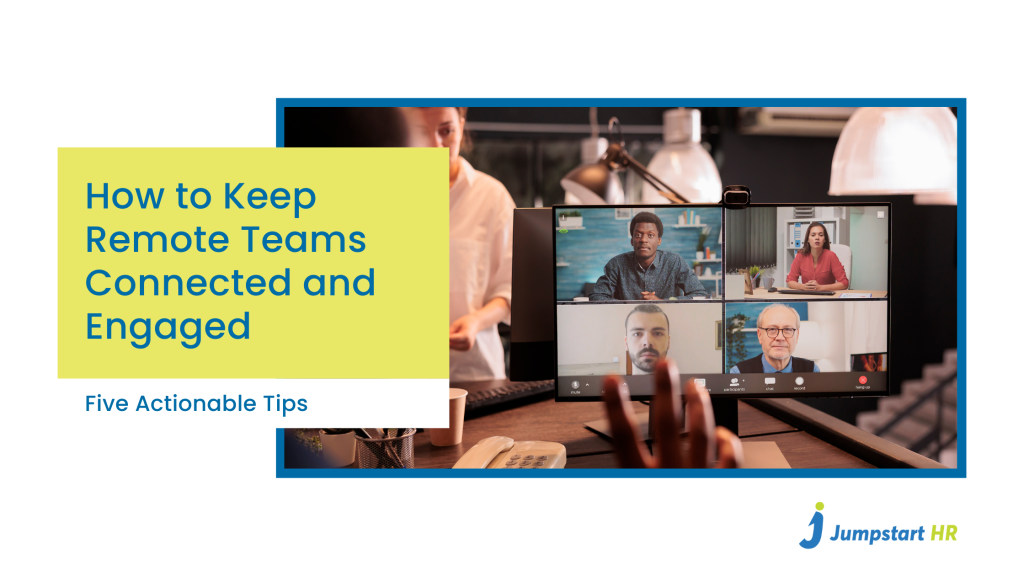
Are you struggling to keep your remote employees engaged and connected—and wondering if it’s starting to cost your business? Need tips to improve your remote work team engagement?
You’re not alone. Many small business owners offer remote work to tap into top-tier talent from anywhere in the country. Maybe you found a rockstar graphic designer in Denver, a social media whiz in Charlotte, or a customer service pro in Phoenix. But while the flexibility of remote work is a competitive advantage, it comes with a serious challenge: maintaining a strong, connected culture when your team is spread out and screen-bound.
The Unique Challenge for Small Businesses
Unlike larger companies with internal HR departments or dedicated employee experience managers, small businesses often make do with limited resources. There’s rarely someone solely responsible for employee engagement, performance management, or morale.
And when remote employees feel disconnected, their productivity, loyalty, and overall effectiveness can quickly decline.
The Hidden Costs of Disengagement
Disengaged employees don’t just “check out” quietly—they quietly cost your business.
You might notice:
Missed deadlines or a lack of urgency in projects
Quiet Zoom calls where no one volunteers ideas
Higher turnover or “quiet quitting” from once-reliable team members
A growing feeling that your once-collaborative culture is slipping away
These aren’t just people problems—they’re business problems. According to research from Aspect43, companies with low engagement suffer from reduced productivity, poor collaboration, and increased burnout.
Want to help us better understand how small businesses like yours are navigating these challenges? Take our quick Insights@Work Survey to shape the future of the modern work experience.
There’s Hope: 5 Smart Ways to Reconnect Your Remote Team
Below are five actionable strategies to help your remote team stay engaged, motivated, and aligned with your business goals.
1. Create a Weekly Ritual That Builds Belonging
Whether it’s a Monday morning check-in or a Friday wins-and-gratitude call, rituals create rhythm and help teams feel like they’re part of something bigger. At Jumpstart HR, we have a mid-week gathering where there’s no agenda and it’s meant for socializing and chit-chat.
Next Step: Schedule a 30-minute “Team Huddle” once a week. Include icebreakers, wins, upcoming priorities, and shout-outs. Rotate who leads the meeting to encourage ownership and participation.
2. Make Recognition a Weekly Habit, Not an Annual Event
Remote employees often miss out on spontaneous praise that happens in office hallways. Recognition builds strong culture and motivates performance.
Next Step: Create a Slack channel or recurring email where you recognize wins each week. Keep praise specific, timely, and values-aligned. If you’re wondering what tools to use, check out our latest research on Talent Experience.
Stay ahead of trends and best practices with research from our HR Tech Analyst division, Aspect43.
3. Invest in Career Conversations, Not Just Performance Reviews
One major reason employees disengage? They don’t see a future at your company. Remote environments can intensify this feeling.
Next Step: Hold quarterly “Stay Conversations” with your team. Ask about goals, challenges, and how you can support their growth. Need a framework? Our Prepaid HR Consulting Package can help you build meaningful structures for talent development.
4. Build Culture Through Communication, Not Just Tasks
A team that only talks about deliverables doesn’t build trust. Informal communication sparks collaboration and boosts morale. We use Monday.com internally for clear project communication amongst clients and team members.
Next Step: Start a “virtual watercooler” space—maybe a Slack channel for pet pics or a monthly “Coffee Roulette” pairing random teammates for a 15-minute chat. See how these remote team engagement tips are working for your company by asking follow up questions over time.
5. Clarify Goals and Accountability—Then Give Flexibility
Remote teams perform best when they know what success looks like. Ambiguity and micromanagement lead to frustration.
Next Step: Use frameworks like OKRs or SMART goals. Hold weekly check-ins and empower employees with autonomy. Let outcomes, not hours, drive performance.
The ROI of Remote Engagement
If you’re reading this, you already value your people. They’re the heart of your company and the future of your brand. A connected, engaged team doesn’t just feel good—it drives results.
Want help putting these ideas into action? Our Prepaid HR Consulting Package gives you expert support to address employee engagement, performance management, and more. It’s flexible, affordable, and designed specifically for small businesses.
Want Even More Insights?
Pick up a copy of my new book The Power of HR—a practical guide for business leaders looking to boost their impact through people strategy. You’ll learn from real-world examples and get proven frameworks to build a people-first company, even without a full-time HR team. It’s also packed with remote team engagement tips on topics like recruitment, people analytics and personnel management.
Let’s Talk About Your Team
Book your free 15-minute consultation with our team today and discover how Jumpstart HR can help you improve team connection and performance. 👉 Schedule here
Help Us Help You (and Other Small Businesses)
Want to help create better workplaces for everyone? Take 3 minutes to complete our Insights@Work Survey from our research division, Aspect43. Your anonymous responses will help shape the future of remote work and employee engagement.
Internal Hiring vs External Hiring Podcast Ft. Fit Small Business
Summary
This episode’s conversation explores the topic of internal versus external hiring in small businesses. Experts from Jumpstart HR and the Fit Small Business team discuss the key differences between the two methods, including the impact on cost, time efficiency, employee morale, retention rates, and diversity of skill sets. They also provide a five-step framework to determine whether to fill a role with an internal hire or an external hire, which includes assessing current skills and gaps, identifying growth and development opportunities, conducting a cost benefit analysis, considering cultural fit and adaptability, and evaluating long-term impact and strategic alignment.
Takeaways
-Internal and external recruitment methods have different impacts on cost, time efficiency, employee morale, retention rates, and diversity of skill sets. -A five-step framework can help small businesses determine whether to fill a role with an internal hire or an external hire: assess current skills and gaps, identify growth and development opportunities, conduct a cost benefit analysis, consider cultural fit and adaptability, and evaluate long-term impact and strategic alignment. -Communication, performance reviews, and feedback are important in assessing current skills, identifying growth opportunities, and promoting internal candidates. -Cost considerations include compensation, benefits, and potential expenses for external hiring, while internal hiring may involve salary adjustments and filling previous positions. -Cultural fit and adaptability should be considered when deciding between internal and external candidates, as well as the long-term impact and alignment with business goals.
Chapters
00:00 Introduction
03:23 Key differences between internal and external recruitment methods
06:00 Cost implications of internal versus external hiring
08:46 Time efficiency of internal and external recruitment methods
14:16 Effect of internal and external recruitment on employee morale and retention
16:31 Impact of internal and external candidate recruiting strategies on diversity of skill sets
21:57 Step 1: Assessment
24:30 Step 2: Identifying
28:04 Step 3: Costs
31:24 Step 4: Culture
31:54 Step 5: Long-term impact and strategic alignment
Talent & Tech: Embracing Collaboration with AI for Workplace Success
Have you ever wondered about the future of your job in the era of Artificial Intelligence (AI)? Is Collaboration with AI a possibility for most workers across the globe?
Join Joey Price, founder of Jumpstart, a national HR consulting firm, as he navigates the potential impact of AI on work and life. First, Joey raises a critical question: Could AI jeopardize our jobs and limit our children’s ability to find fulfilling careers? Secondly, through personal anecdotes, he sheds light on the transformative influence of AI, and underscores the ethical considerations surrounding AI. Finally urging the audience to envision a future where AI is an ally, not a threat, creating workplaces that inspire excitement.
In a compelling call to action, Joey advocates for the responsible development of AI, ensuring it enhances human potential and prioritizes the well-being of workers in this new era. Join Joey Price on this captivating exploration of AI’s role in reshaping our work and lives.
Joey V. Price is an award-winning Human Resources Executive, thought leader, and the Founder and CEO of Jumpstart:HR. The company offers HR outsourcing and consulting for startups and small businesses. Joey also co-hosts the “While We Were Working” weekly podcast for leaders in the workplace who wish to be better at handling people’s issues. A seasoned HR professional with hands-on experience in multiple organizations, Joey advocates for businesses to translate their goal into high ROI through happily engaged staff members. He also serves on the Advisory Board for the HR Department at the Forbes School of Business and Technology, the UKG Workforce Institute, and the Ethics in AI Board at Arena Analytics. This talk was given at a TEDx event using the TED conference format but independently organized by a local community. Learn more at https://www.ted.com/tedx
Welcome to another insightful episode of the “While We Were Working” HR podcast! In this episode, we delve into the latest developments surrounding the PUMP Act and the question of whether Form I-9’s need to be completed in person. Join our expert panel as we discuss the implications of these new requirements and their impact on employers and employees alike.
Timestamps:
00:00 – Introduction
01:59 – Understanding the PUMP Act: Exploring its new requirements (While We Were Working Segment)
15:04 – Form I-9: In-person completion or remote alternatives? (Consultant’s Corner Segment)
Episode Details:
In this engaging HR podcast episode, our knowledgeable hosts dive deep into the intricacies of the PUMP Act, shedding light on the updated requirements that organizations need to be aware of.
We analyze the key aspects of the legislation and explore its potential implications on businesses, employee rights, and compliance obligations.
Form I-9, a crucial document for verifying employment eligibility, has traditionally required in-person completion. However, in light of evolving workplace dynamics and the impact of the COVID-19 pandemic, we examine whether digital alternatives and remote completion options can be considered viable alternatives.
We discuss the benefits and challenges associated with these approaches and provide practical insights for employers navigating this changing landscape.
As we unravel the complexities surrounding the PUMP Act and Form I-9 requirements, our expert panel offers valuable perspectives and actionable advice.
Gain insights into compliance considerations, best practices, and the potential consequences of non-compliance.
Whether you are an employer, HR professional, or an employee seeking clarity on these matters, this episode equips you with the knowledge needed to adapt and comply with the new regulations.
Tune in to the “While We Were Working” podcast and join the conversation surrounding the PUMP Act and the evolving landscape of Form I-9 completion.
Stay informed, make informed decisions, and ensure compliance in this ever-changing world of employment regulations with our weekly HR podcast.
Don’t forget to like, subscribe, and share this episode with others who may find this information valuable. Stay tuned for more engaging discussions on the “While We Were Working” podcast!
Do you need to outfit a room at your office for PUMP Act compliance? Check out this chair and more from Amazon.com
Before we talk about building a team, let’s take a walk down memory lane.
Do you remember the first time you were on a team? It could’ve been a second-grade soccer team where everyone got a trophy at the end of the year regardless of how well the team did. Or it was later in life, a twelfth-grade capstone project that required collaboration for completion. No matter when you experience your first time being on a team, there’s one truth about them: they’re everywhere. So how can something so common be consistently mismanaged? It may have more to do with what we believe about teams in the first place.
“A team is more than a collection of people. It is a process of give and take.” – Barbara Glacel
In this article, I want to share the three myths that small businesses believe when building a team, why I think these myths exist, and how to overcome them. If these resonate with you, please share them with your team and consider working with mine.
Myth 1 when building a team: The right candidate is LOOKING for your business.
Every day in America, companies post, pray, and ponder over job descriptions, hoping they’ve cooked up the right recipe for the ideal candidate to manifest in their applicant tracking system and solve all their workload and team chemistry woes.
Building a team is hard and I’ve even been there myself. Thinking that the only thing standing between our open positions and success is a fresh job description with KPIs and culture. Unfortunately, this couldn’t be further from the truth. Unless you are a household name like Apple or Amazon, how can we be so sure that someone even knows to look for us in the first place? Of course, we believe in our brand, mission, and team – but what do we do consistently to raise awareness about our businesses and their inner workings? Suppose you want to be found by the right candidate. In that case, you must think beyond the traditional job description and share what it’s like to work in your company. These days, 70% of job seekers are passive.
Stop believing that the right candidate is LOOKING for your business. More often than not, it would be best to source the right candidate for your business. What is sourcing? It’s when you proactively find candidates instead of posting a job and sifting through hundreds of candidates. As you make this shift when building a team, you feel empowered to make proactive decisions to land your next key hire. One potential decision you should consider making? Work with a recruiting agency that will source talent and use tools that reduce the time and cost it takes to hire for your organization.
Myth 2 when building a team: The right hire comes from the right school or company.
While so much has changed over the last decade within the recruiting industry, only some hiring managers have kept up.
There was once a time when notable schools and companies were reliable pipelines to fill cookie-cutter jobs with predictable expectations. I remember the days when building a team meant that applicants from relevant universities or companies were given an automatic second look – even if their qualifications weren’t quite there. Some would even get the benefit of the doubt when it came to salary since “they used to work at [fill in the blank], they must be good!” The problem with this way of thinking now (and quite frankly, always) is that it presents an unconscious bias against high-potential talent from non-traditional or traditional backgrounds without name recognition. Take the world of IT, for example, where the US Bureau of Labor Statistics says 25% of IT workers have no college degree. Are you willing to risk passing on game-changing talent because they don’t come from the background you envisioned they would?
Instead of believing the right hire comes from the right school or company, you should know that the right candidate can articulate their skills and how they align with what you need them to do. Interviewing is all about asking excellent questions and developing mutual trust. The next time you have an opportunity to chat with a candidate with the right experience but not the right name on their diploma, break out a few good questions where you ask them to describe their experience and what challenges they’ve faced along the way. Don’t hire based on which mascot they cheer for during March Madness; employ a team member for their ability to make an impact on your team today and tomorrow.
Myth 3 when building a team: We hire to find the right person.
One of these days, I might write a book about the parallels of marriage and building a team – but that’s a story for another time.
Right now, though, I want to address a myth we’ve been carrying for years in small business circles: there are no unicorns, ninjas, or rockstars. Instead, there are hidden gems, high-potential hires, and developmental candidates you take a chance on because you see something. Companies often want to pass on great candidates in hopes of finding “the one.” It prolongs the search process, adds extra costs, and reduces the candidate experience for everyone. You rarely find someone better qualified than the candidate you passed on because they nailed four things but were “eh” on the fifth.
Instead of believing you recruit to find the right person, consider recruiting to find someone competent in the role that vibes with your culture and is willing to be developed. Since we’re on the topic of teams, let me speak about a sports analogy: The NBA Draft. The most successful teams in the draft aren’t the ones who waste time trying to find someone who will be an MVP right away. The most successful teams in the draft are the ones who look at their organization’s style of play, which prospects play a similar kind of basketball, and who will train and study to perform at their best over time. It’s impractical to think there’s a perfect ready-made hire out there. Why? You have a unique culture, unique management structure, and maybe a few skeletons in your operational closet.
If you think about hiring as a big-picture project, your new hire will figure out how to paint themselves in that picture with you.
While the four-day work week is not yet universal, most citizens enjoy the pleasures of added three-day weekends during the year.
– Michael From
The idea of a 4-day work week has gained popularity in recent years, with some small businesses opting to implement this schedule in order to increase productivity and improve employee satisfaction. However, before making the switch to a 4-day work week, it’s important to consider both the pros and cons.
Pros of Implementing a 4-Day Work Week:
Increased productivity: By condensing the workweek, employees have more time to rest and recharge, which can lead to a more productive and engaged workforce.
Reduced burnout: The added day off each week can help to reduce stress and burnout among employees, leading to a more positive work environment.
Attracting and retaining employees: A 4-day work week can be an attractive benefit for potential employees, making it easier for small businesses to attract and retain top talent.
Cost savings: A 4-day workweek can lead to cost savings for small businesses, as they may need to pay less for utilities, office space, and other expenses associated with keeping the office open an extra day.
Cons of Implementing a 4-Day Work Week:
Reduced hours for employees: A 4-day work week can mean that employees work longer hours on the days they are in the office, which can be tiring and lead to decreased productivity.
Reduced availability: With a shorter workweek, small businesses may be closed an extra day, which can make it harder for customers to reach them.
Difficulty with scheduling: A 4-day workweek can make it harder for small businesses to schedule meetings and appointments, as everyone may not be available on the same days.
Difficulty accommodating with unexpected events: A 4-day workweek can make it harder for small businesses to handle unexpected events, such as a rush of customers or an emergency repair, as they may not have enough staff on hand.
Listen to our Small Business HR podcast:
If you are considering implementing a 4-day workweek, here are some practical tips for making it work:
Communicate with employees: Make sure to talk to your employees about the potential change and get their input.
Test it out: Consider starting with a trial period to see how a 4-day workweek works for your business and your employees.
Be flexible: Be willing to adjust the schedule as needed to accommodate the needs of your employees and your business.
Plan ahead: Make sure to plan ahead for meetings and appointments, so that everyone is available on the same days.
Be prepared for unexpected events: Have a plan in place for handling unexpected events, such as having a designated employee who can come in on their day off in case of an emergency.
Overall, a 4-day workweek can be a great option for small businesses looking to increase productivity and improve employee satisfaction. However, it’s important to carefully consider the pros and cons and be prepared to make adjustments as needed to make it work for your business.
Want to see if a 4-Day Work Week can work for your business? Contact us today.
Used to monitor number of Google Analytics server requests when using Google Tag Manager
1 minute
_gid
ID used to identify users for 24 hours after last activity
24 hours
_gac_
Contains information related to marketing campaigns of the user. These are shared with Google AdWords / Google Ads when the Google Ads and Google Analytics accounts are linked together.
90 days
_gali
Used by Google Analytics to determine which links on a page are being clicked
30 seconds
_ga
ID used to identify users
2 years
__utmx
Used to determine whether a user is included in an A / B or Multivariate test.
18 months
__utmv
Contains custom information set by the web developer via the _setCustomVar method in Google Analytics. This cookie is updated every time new data is sent to the Google Analytics server.
2 years after last activity
__utmz
Contains information about the traffic source or campaign that directed user to the website. The cookie is set when the GA.js javascript is loaded and updated when data is sent to the Google Anaytics server
6 months after last activity
__utmc
Used only with old Urchin versions of Google Analytics and not with GA.js. Was used to distinguish between new sessions and visits at the end of a session.
End of session (browser)
__utmb
Used to distinguish new sessions and visits. This cookie is set when the GA.js javascript library is loaded and there is no existing __utmb cookie. The cookie is updated every time data is sent to the Google Analytics server.
30 minutes after last activity
__utmt
Used to monitor number of Google Analytics server requests
10 minutes
__utma
ID used to identify users and sessions
2 years after last activity
SourceBuster is used by WooCommerce for order attribution based on user source.
Name
Description
Duration
sbjs_migrations
Technical data to help with migrations between different versions of the tracking feature
session
sbjs_current_add
Timestamp, referring URL, and entry page for your visitor’s current visit to your store
session
sbjs_first_add
Timestamp, referring URL, and entry page for your visitor’s first visit to your store (only applicable if the visitor returns before the session expires)
session
sbjs_current
Traffic origin information for the visitor’s current visit to your store
session
sbjs_first
Traffic origin information for the visitor’s first visit to your store (only applicable if the visitor returns before the session expires)
session
sbjs_udata
Information about the visitor’s user agent, such as IP, the browser, and the device type
session
sbjs_session
The number of page views in this session and the current page path
30 minutes
Marketing cookies are used to follow visitors to websites. The intention is to show ads that are relevant and engaging to the individual user.
Facebook Pixel is a web analytics service that tracks and reports website traffic.
This cookie is used to play YouTube videos embedded on the website.
2 years
DEVICE_INFO
Used to detect if the visitor has accepted the marketing category in the cookie banner. This cookie is necessary for GDPR-compliance of the website.
179 days
YSC
Registers a unique ID to keep statistics of what videos from YouTube the user has seen.
Session
PREF
This cookie stores your preferences and other information, in particular preferred language, how many search results you wish to be shown on your page, and whether or not you wish to have Google’s SafeSearch filter turned on.
10 years from set/ update
VISITOR_INFO1_LIVE
Tries to estimate the users' bandwidth on pages with integrated YouTube videos. Also used for marketing
179 days
GPS
Registers a unique ID on mobile devices to enable tracking based on geographical GPS location.